
You have likely encountered the standard advice: use “I” statements, practice active listening, take turns speaking. These communication tools are staples of couples therapy for good reason. They work. But when one partner carries trauma, these same reliable techniques can falter, or even backfire. The problem is not a lack of skill or effort. It is that trauma fundamentally alters the space between two people, making the standard rules of engagement ineffective.
This post analyzes why couples work must adapt when trauma is present. We will examine why the tools that succeeded elsewhere fail here, what trauma does to a relationship, and what the evidence actually shows about conjoint treatment for PTSD. You will learn what needs to be built first: safety, predictability, and a slowed-down cycle. We will then redefine the partner’s role as supportive, without asking them to become a therapist or rescuer, and explore when to seek trauma-informed couples therapy. The goal is not to abandon communication, but to build the foundation upon which it can finally work.
Why the Tools That Worked Everywhere Else Fail Here
You did the worksheets. You learned the I-statements. You practised active listening. And the same argument returned, or escalated. That is a common and demoralising experience, not evidence that you failed the exercise.
Clinically, we think of this as a sequencing problem, not a phrasebook problem. When one partner is trauma-activated, the nervous system is scanning for threat rather than processing information. A calm “I feel hurt when…” can land as a demand, a warning, or a setup for blame. Hyperarousal and avoidance narrow what a person can take in. Tone, timing, and perceived safety carry more weight than sentence structure, so phrasing tweaks alone often move nothing. The Gottman Method couples therapy online: Four Horsemen at home framework can help couples see the pattern, but trauma work has to set the conditions first.
A correction matters here: no study in this body of research directly tests whether standard communication exercises backfire. It is a pattern clinicians see, not an established finding.
The pilot randomised trial of 46 couples is instructive. Its CBCT-CS arm, which received communication-skills content from Phases 1 to 2, produced medium-to-large improvements within the group. There was no significant between-group difference in PTSD change versus mindfulness-based CBCT: mean difference −1.4 points, 95% CI [−16.0 to 13.2]. The tools are not the problem. The order and the container are what change.
What Trauma Does to the Space Between Two People

Once you stop treating the problem as a communication gap, the pattern becomes easier to see. Intrusion or heightened arousal produces irritability or withdrawal. The partner reads anger or distance, reacts, and both people end up regulating each other’s distress rather than the trauma itself. This is why the argument feels circular: two nervous systems are responding to threat cues, and the content of the argument is often not the actual subject.
That cycle has a measurable corollary: partner accommodation. It is a defined treatment target, not a character flaw. It looks like pre-emptively cancelling plans, taking over responsibilities, monitoring moods, avoiding topics, and managing the household around symptoms. In a real-world VA sample of 113 couples, accommodation fell significantly from pre- to post-treatment (d = 0.44) (Pukay-Martin et al.).
Avoidance then becomes shared. Couples stop going certain places, stop initiating sex, stop talking about the deployment, the assault, the loss or the childhood, and the relationship quietly shrinks to fit around the trauma. What looks like poor communication is better understood as a regulation problem.
This framing draws on trauma treatment models. The evidence base for conjoint trauma work is largely cognitive behavioural conjoint therapy for PTSD, studied mostly with military veterans. The principles may translate to other couples, but that generalisation is not established by the research cited here. The next question is what the evidence actually shows about couple therapy.
What the Evidence Actually Shows About Couples Work and Trauma
That caution is warranted, because the research base is narrower than most relationship advice suggests. Cognitive behavioural conjoint therapy for PTSD is a structured 15-session protocol that treats the individual’s PTSD while deliberately incorporating the partner. It does not treat the relationship as a side issue.
Real-world outcomes from a VA sample of 113 veterans are encouraging: veteran-rated PTSD symptoms fell significantly (d = 0.69), depressive symptoms fell (d = 0.75), and relationship happiness rose for veterans (d = 0.36) and partners (d = 0.35). Partners rated PTSD symptoms as rising first, then falling (d = 0.24). Early weeks can look worse before they look better, and that transient worsening is not evidence the therapy is failing.
The inconvenient result matters. In a pilot randomised trial of 46 couples, the communication-skills-only control group did real work: medium-to-large within-group effects and no statistically significant between-group differences on PTSD or dyadic adjustment. The honest reading is that skills plus safety is stronger than either alone, not that skills are useless.
The limits are equally clear. This is essentially one model, mostly with veterans, mostly in VA settings. It does not establish outcomes for teens, non-military couples, first responders, or Black men and boys specifically. For those groups, the principles are a possible translation, not a demonstrated effect. Where individual trauma work runs alongside couples work, evidence-based treatments such as EMDR, CPT and Prolonged Exposure may be coordinated by the clinician.
What Gets Built First: Safety, Predictability, and Slowing the Cycle
If the evidence stops short of prescribing an order, clinical reasoning fills the gap: slow the cycle before attempting to resolve anything inside it. Lengthen the gap between activation and response. Expect a therapist to interrupt escalation rather than coach a couple through it live, which is the opposite of what most skills-based sessions do.
Safety is defined observably, not as a feeling. No shouting. No ambush conversations. No redeploying a disclosed trauma as ammunition in a later argument. Agreed exits that carry no punishment afterwards. Honest reporting of what happened during a pause.
Predictability is treatment: consistent session structure, agreed signals for stopping a conversation, routines that reduce surprise, and clear expectations about who does what when someone is activated.
Session mechanics follow the same logic. Shorter segments, structured turn-taking, grounding before content, applying the same pacing principles that keep online EMDR safe, and a brief review after any activation so the couple learns from it rather than merely surviving it.
No research tests this pacing or sequence in couples work. The approach is reasoned from how trauma affects arousal and threat detection, and a therapist should adjust it to what the relationship can hold. Where anger arrives before any other signal, that regulation work usually runs alongside trauma treatment rather than instead of it, as explored in therapy for emotional regulation in men.
The Partner’s Role: Supportive Without Becoming Therapist or Rescuer
Slowing the cycle creates room, but it does not tell partners what to do with that room. Support is presence, steadiness, and follow-through. Therapy is trauma processing, exposure work, and clinical decisions. A partner can do the first well and should not attempt the second.

Rescuing is easy to mistake for support. It looks like preemptively cancelling plans, speaking for the other person, tracking triggers as a full-time job, absorbing verbal abuse in the name of trauma, or becoming the only person the trauma-carrying partner talks to. These patterns map onto partner accommodation, a defined treatment target. In a real-world VA sample of 113 veterans, accommodation improved significantly from pre- to post-treatment (d = 0.44). The research does not define a specific partner role protocol. The guidance here is clinical reasoning built on that finding, not a validated curriculum.
Actionable moves: ask what actually helps rather than assuming; keep your own individual therapy or peer support; name your own limits without ultimatums; let a clinician hold the trauma work.
If you are the partner carrying trauma, including men reading about themselves: you are not the problem in the room. Needing help is not the same as being the reason the relationship is struggling.
Does Couples Therapy Work When One Partner Has PTSD?
Support without rescue works best inside a clear treatment plan. Does couples therapy work when one partner has PTSD? Yes, with caveats. The best-known conjoint protocol is commonly described as a 15-session course, but published formats vary and real-world pacing depends on symptom severity, safety, and how much individual trauma work is running alongside. Conjoint models treat one person’s PTSD while incorporating the partner; individual trauma treatment such as EMDR or Prolonged Exposure can run in parallel. ProSightful offers both, so the two tracks can be coordinated rather than duplicated.
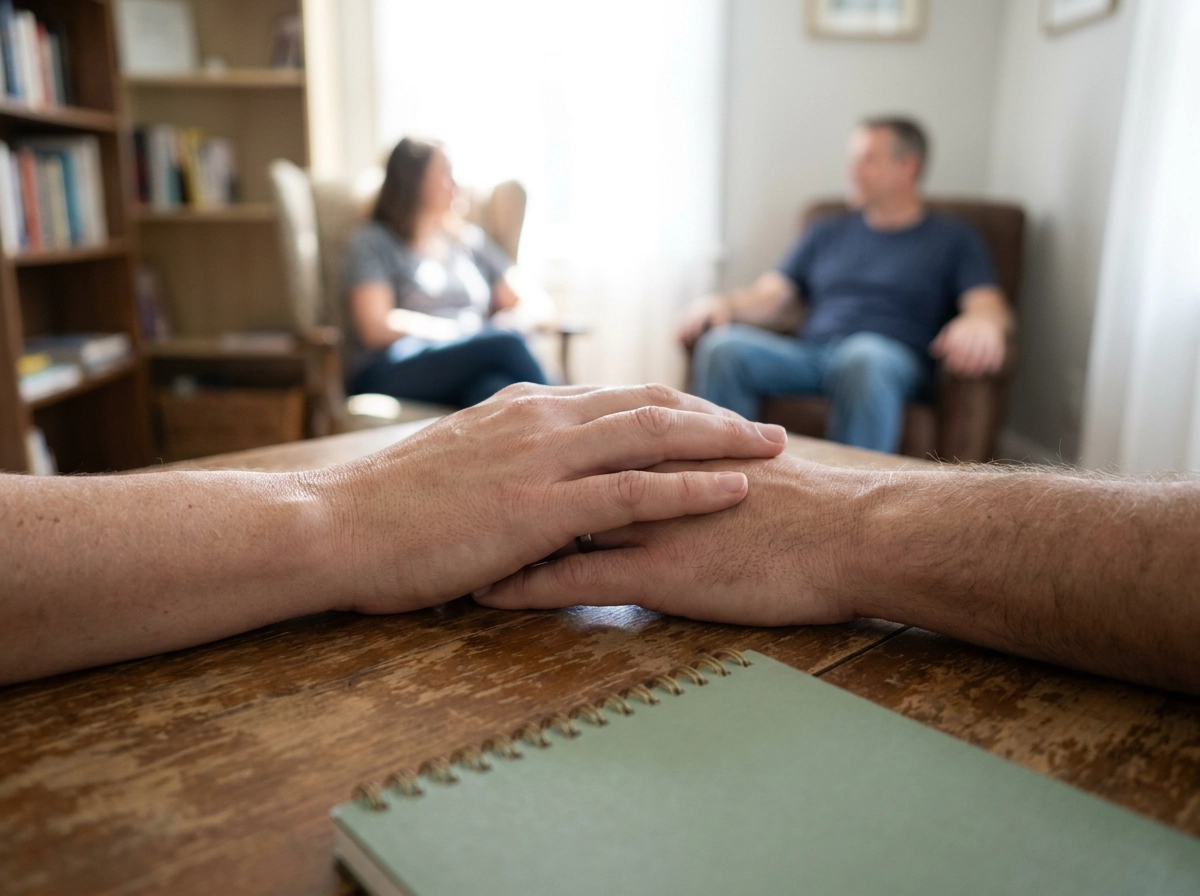
If your partner will not attend, individual trauma treatment still helps. A partner can also seek individual counselling and education about accommodation without waiting for agreement.
Telehealth makes weekly consistency more realistic. ProSightful Counseling and Consulting provides telehealth therapy for couples, individuals and families in Texas, Nebraska and Iowa, subject to clinician licensure and eligibility.
Intimacy can become a minefield after trauma, and it is a legitimate treatment target rather than a side effect to endure. It can be addressed directly with a clinician trained in both trauma and sex therapy. Where criticism, defensiveness, contempt or stonewalling have become routine, Gottman Method Couples Therapy Online: Four Horsemen at Home explains the patterns therapy targets.
This is not a fixed recipe. Ask how the clinician sequences couples work, individual trauma treatment, and intimacy work for your relationship.
When to Seek Trauma-Informed Couples Therapy
If those questions feel familiar, certain patterns suggest the work needs a trauma-informed frame rather than a general relationship tune-up: the same argument on repeat with no resolution, one partner walking on eggshells, avoidance spreading into more areas of life, and one person carrying all the emotional regulation for the relationship. That combination is the signal to seek trauma-informed couples work.
The first step can be low pressure. A consultation is a conversation, not a commitment, and a reasonable place to ask whether a therapist works with trauma and couples together rather than treating them as separate problems.
ProSightful Counseling and Consulting offers couples therapy using the Gottman Method Couples Therapy Online: Four Horsemen at Home, trauma and PTSD treatment, EMDR, Prolonged Exposure therapy, individual counselling, and sex therapy when intimacy has become part of the injury. These are services offered, not claims about comparative effectiveness.
For partners supporting a man who carries trauma, and for men used to handling everything alone, services are designed so that seeking help does not read as an admission of failure.
Telehealth sessions are available in Texas, Nebraska, and Iowa, subject to clinician licensure and eligibility. Prelicensed clinicians can also find clinical supervision through the practice.
What to Do With This
If the communication tools did not work, that is information about the order of the work, not about your relationship’s ceiling. Safety and predictability come before technique, which is why the same exercises that failed in a crisis can become useful once the environment has settled.
Accommodation is the most telling target in the room. The evidence shows that couples who accommodate more at the outset tend to improve more when it is addressed directly, so stop managing your partner’s symptoms for them and start asking what actually helps.
Expect a rough stretch. In real-world data, partner-rated symptoms initially rose before they fell. Early weeks that feel worse are not proof of failure; they are often the point at which the work has finally started.
Partners get support too, not just the person carrying the trauma. Individual therapy, peer support, and clearly stated limits protect the relationship far more than self-sacrifice does. Recognising when that support is needed is itself a skill, and recognising the signs it is time to seek therapy can help you decide without waiting for a crisis.
No single approach is proven for every couple. Ask a clinician directly what they are trained in, what the evidence supports, and how they will pace the work for your relationship. A consultation is a conversation, not a commitment, and it is the sensible next step if any of this sounds familiar.
Conclusion
The tools did not fail your relationship. They arrived out of order. Safety and predictability come before technique, and addressing accommodation directly is what the evidence supports most. Early weeks may feel worse before they feel better, and that is often the work beginning, not failing.
Partners need support too. Individual therapy, peer support, and clear limits protect the relationship more than self-sacrifice ever will. No single approach works for every couple, so ask a clinician what they are trained in and how they will pace the work.
A consultation is a conversation, not a commitment. If any of this sounds familiar, take that step. You have already started by understanding what trauma does to the space between two people. Now give that understanding somewhere to go.
Frequently Asked Questions
Why do standard communication techniques like I-statements and active listening fail when one partner has trauma?
When one partner is trauma-activated, the nervous system is scanning for threat rather than processing information, so even calm phrasing can land as a demand, warning, or blame. Hyperarousal and avoidance narrow what a person can take in, and tone, timing, and perceived safety matter more than sentence structure. The problem is usually sequencing rather than skill: safety and a slowed-down cycle need to be established before communication tools can work. Note that this is a clinical pattern, not a finding tested directly by research.
What is partner accommodation, and why does it matter?
Partner accommodation includes behaviours like pre-emptively cancelling plans, taking over responsibilities, monitoring moods, avoiding topics, and managing the household around symptoms. It is a defined treatment target rather than a character flaw. In a real-world VA sample of 113 couples, accommodation fell significantly from pre- to post-treatment (d = 0.44). Addressing it directly is one of the most telling steps in the work.
Does couples therapy work when one partner has PTSD?
Yes, with caveats. The best-known conjoint protocol, cognitive behavioural conjoint therapy for PTSD, is a structured 15-session course studied mostly with military veterans in VA settings. In that sample, veteran-rated PTSD symptoms and depressive symptoms fell significantly, and relationship happiness rose for both veterans and partners. Evidence does not yet establish outcomes for non-military couples, teens, first responders, or other groups, so the principles may translate but are not proven for them.
Is it normal for symptoms to get worse early in trauma-focused couples therapy?
Yes, it can be. In the real-world VA data, partners rated PTSD symptoms as rising first and then falling. Early weeks can look worse before they improve, and that transient worsening is not evidence that therapy is failing. Ongoing communication with the clinician about what you are noticing helps the team pace the work appropriately.
What if my partner refuses to attend couples therapy?
Individual trauma treatment still helps, and the partner can benefit as well. The partner can seek individual counselling and education about accommodation without waiting for agreement, and support from individual therapy or peer support can protect the relationship. The partner's role is supportive, not therapeutic: they should not attempt trauma processing or take on the role of therapist or rescuer.