
You ask your teenage son how he is doing, and he says, “I’m fine.” But you have noticed he is sleeping more, snapping at everyone, and spending most of his time alone in his room. The gap between “I’m fine” and what you are actually seeing is where most parents get stuck. This post is here to help you close that gap.
You do not need a clinical checklist to start. Instead, you will learn a practical decision rule based on three factors: duration, day-to-day function, and total withdrawal. We will walk through what distress often looks like in teenage boys, how to open a conversation so he actually talks, and when waiting is no longer the right call. We will also cover why a video session often clears the biggest barrier that keeps boys from getting help. By the end, you will have a clear plan for this week: what to watch, what to say, and when to reach out.
Why “I’m Fine” Is Often True and Still Incomplete
“I’m fine” is rarely a lie. For most teenage boys it is the shortest honest answer, because they lack words for irritability, numbness or dread. Ask “are you sad?” and you get a blank look. It is true and incomplete. If irritability dominates, know that anger often sits on top of something else. Concern is reasonable, not proof of a problem: children can struggle quietly even when grades hold and daily life looks normal. Nationally, persistent sadness or hopelessness among high school students fell from 42% in 2021 to 40% in 2023 (CDC), a small shift, not a resolution. What follows is practical parenting guidance to help you organize what you see and choose a next step. It is not a diagnostic standard and does not replace a licensed clinician’s assessment.
What Distress Usually Looks Like in Teenage Boys
Irritability often precedes sadness: snapping over small things, shorter fuse, sudden anger at family, more home conflict than before. In teen boys this reads as “attitude” but is closer to overwhelm.
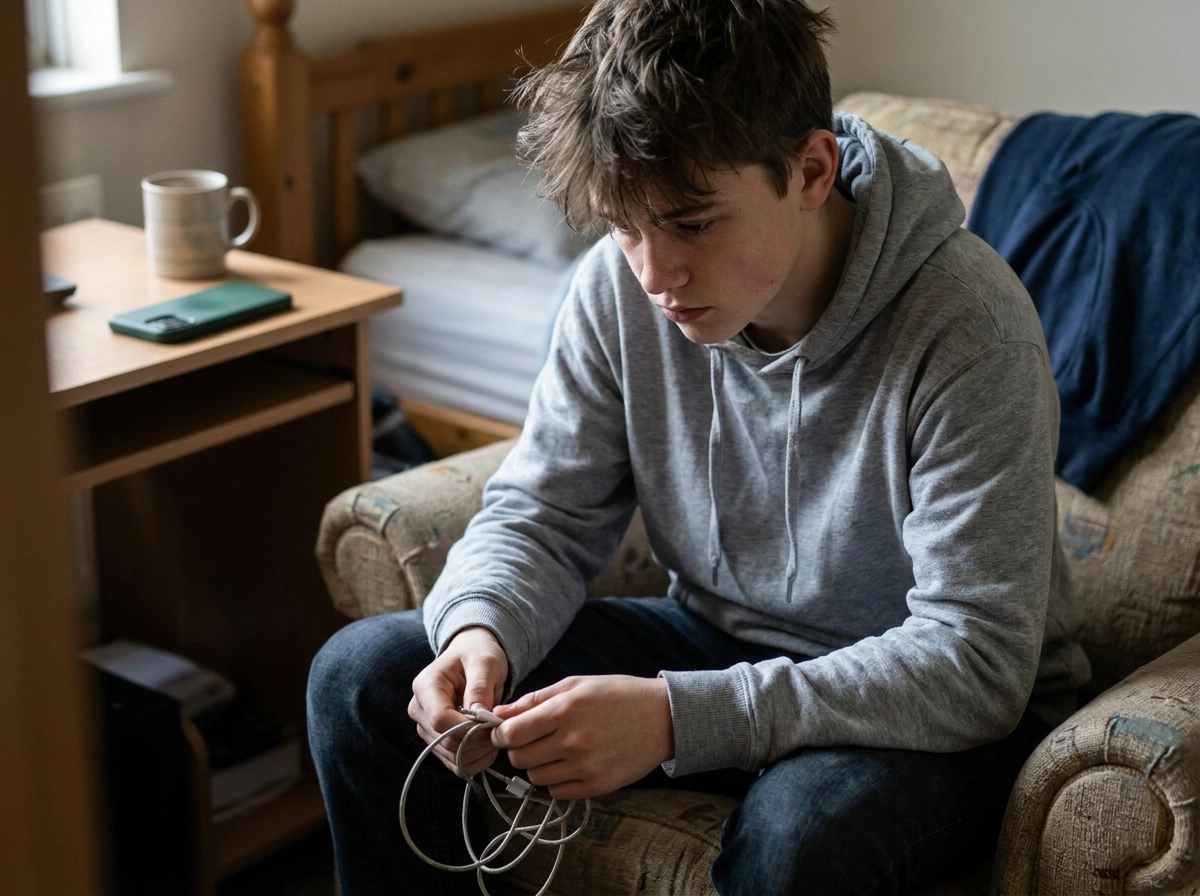
Sleep changes either way: 10 to 12 hours and exhausted, awake past midnight, or awake all night and asleep all day. Sleep moves early in a struggling teen and is easy for parents to observe.
Withdrawal from everything, not one thing. Quitting sport is a data point. Quitting sport, dropping the friend group, abandoning a long-running hobby, and weeks behind a closed door is a pattern.
Watch for recurring headaches or stomachaches, appetite change, poor concentration, slipping grades, and lost interest in his identity activity.
Caution: boys showing irritability and withdrawal instead of sadness is a common clinical and parenting observation, not proven population-level data. CDC’s sex-specific breakdowns have focused on female students, who reported higher rates of persistent sadness than male students in both 2021 and 2023. No boy-specific data does not mean boys are fine; parents must rely more on what they see at home.

The Wait or Get Help Decision Rule: Duration, Function, Withdrawal
Since boy-specific data is thin, you will rely heavily on what you observe at home. Here is the decision rule: judge three things together rather than any single sign on its own.
- Duration: How long has this been going on?
- Function: Is day-to-day life still working?
- Withdrawal: Has he pulled away from everything, or just stepped back from one thing?
A hard two or three weeks from a clear trigger can resolve on its own.
One alarming sentence is not something to wait on. If your son says something frightening, that skips the rule entirely and goes straight to the escalation section below.
Be honest about what this rule is: practical guidance to help you sort normal turbulence from something that needs a professional. It is not a validated screening tool or a clinical cutoff. Diagnosis comes from a trained clinician using structured assessment.
Your instinct counts as information. You are not required to satisfy every criterion before asking for help. If something feels wrong after weeks of watching, that feeling is a legitimate reason to make a call.
Duration: How Long Is Too Long?
Two to four weeks is a practical parent heuristic, not a clinical cutoff and not drawn from a single authoritative guideline. If low mood, irritability, or flatness is present most days for two to four weeks and not lifting, that duration alone justifies a professional conversation. The NHS says early help matters because longer depression disrupts more.
Judge direction. A hard stretch that improves week over week differs from one that stays flat or worsens. As a rule of thumb, worsening over several weeks is a stronger signal than a bad ten days.
Separate a reaction from a baseline shift. Grief, disappointment, and stress have a cause you can name and a shape that softens. A baseline shift has no clear trigger and does not ease.
Do not wait for a school year or season to end if things are worsening. Time is not neutral when a teen is isolating.
If you cannot tell whether it has been two weeks or two months, that uncertainty is common. A video consultation can sort it out without committing to therapy.
Function: Is Day-to-Day Life Still Working?
Duration tells you how long something has lasted. Function tells you how much it is costing him.
Five questions give you a working picture: Is he attending school? Is he eating? Is he sleeping enough to function? Does he still invest in at least one relationship? Does he still do one thing he enjoys?
If most areas hold with occasional hard days, watchful waiting is reasonable. If two or more are slipping, get help sooner rather than later.
Look for function that is technically present but hollow. A teen at school who spends lunch in the parking lot, or eating only at 11 p.m., is not functioning the way attendance suggests. Watch hygiene too: a previously put-together kid who stops showering is showing you what words have not.
Judge function over mood. A teen can say he feels fine while his structure, sleep, and connection visibly fall apart.
Withdrawal: Has He Pulled Away From Everything?
Where function measures output, withdrawal measures desire. This is the criterion parents most often underestimate.
Count the exits, not the mood. Total withdrawal means the exits have closed one by one: social, physical, academic, recreational.
Watch for withdrawal that comes with a story attached: “nobody likes me anyway” or “there’s no point.” Justifying isolation is a different signal than preferring downtime.
Check whether he has anyone. One trusted adult, one friend, one coach, one cousin can be protective. Zero connections and no interest in building any is a different level of concern.
If withdrawal is total and has lasted over a month, act. Do not wait for him to ask for help; withdrawal itself is what makes asking unlikely.
How to Open the Conversation So He Actually Talks
If you have counted the exits and something still feels wrong, skip the sit-down interrogation. Teenage boys often talk more freely side by side: in the car, walking the dog, shooting baskets, folding laundry, or during a late-night kitchen run. A table talk can feel like a performance review.
Lead with observation, not diagnosis: “I noticed you’ve been up until 3 a.m. most nights and stopped going to practice. I’m not mad and I’m not trying to fix anything today. I just want to know what’s going on with you.”
Ask one question, then be quiet. Let him take the turn. Replace “why” with “what” and “how”: “What’s been making this week hard?” invites information; “Why are you so angry?” invites defence.
Lower the stakes aloud: “You don’t have to have it figured out. You’re not in trouble. I’m not going to make you talk about it for an hour.” If he says “I’m fine,” don’t argue. Leave the door open: “Okay. I’m here whenever that changes, and I’d rather hear it than guess.” Return in a few days without re-litigating.
Make it two-way. Share one honest thing about your own week at the same depth you are asking for. A conversation gets further than an assessment.
When to Stop Waiting and Get Help Now
If conversation reveals a listed sign, skip the waiting period.
Suicide, self-harm, or not wanting to be here talk is taken seriously every time. Call/text 988 for free, confidential, 24/7/365 help, or go to an emergency room. Do not leave him alone meanwhile. Many clinicians and crisis organisations advise that directly asking about suicide is appropriate; if you are uncertain how to ask, the 988 counsellor can guide you.
Act today, not in a month, for sudden severe withdrawal (stops school entirely, will not leave his room, stops eating or drinking normally); inability to function (cannot get out of bed, manage basic hygiene, or is flat and unresponsive to things that used to matter); symptoms suggesting a break from reality (hearing or seeing things others do not, disorganized speech, unusual paranoia, clear departure from normal thinking and speaking); or escalating safety risk at home (threats toward himself or others, increasing violence, or access to weapons plus any above).
For immediate-safety doubts, choose the emergency room over a scheduled appointment. If serious but not immediate, video consultation can be fastest assessment; learn more about when it’s time to seek therapy. ProSightful Counseling serves teens and families in Texas, Nebraska, and Iowa, subject to clinician licensure and eligibility.
Why a Video Session Clears the Objection That Keeps Boys Out
Booking is often harder than the session. Many teenage boys may refuse quietly if seen in the clinic waiting room, missing practice, or explaining to a friend. That refusal is usually about exposure, not unwillingness to improve.
Video removes practical friction: no drive time, no lobby, no collision with school, work, or practice, no unfamiliar building. Telehealth is a well-established access option, but research on whether it specifically keeps adolescent boys engaged is still developing. Treat it as barrier reduction, not a proven fix.
Privacy and control matter. In video he chooses room, chair, lighting. Many teens talk more freely when not studied across a desk.
Consistency beats format. Therapy that works is therapy he attends, so a video session he shows up for beats a clinic he skips.
ProSightful Counseling provides telehealth therapy for teens, young men, adults, couples, and families, including individual counselling, family work, and trauma treatment (EMDR, Prolonged Exposure) when clinically indicated. Coverage depends on state and clinician licensure; confirm eligibility before booking via frequently asked questions.
What to Expect If You Do Reach Out
The practical steps of a video session matter less than what happens inside it. Knowing the likely shape of early appointments helps you prepare your son and set realistic expectations.
Expect the first session to centre on assessment and history. You will usually provide background first, then the clinician spends time with your son directly. Later sessions may involve family therapy sessions depending on what is needed.
Expect rapport before problem-solving. Early sessions may look like low-stakes conversation about games, school, or music. That is not wasted time; it is what makes harder conversations possible later.
Ask about confidentiality and its limits upfront, then explain them to your son in advance. Teens engage more when they know what will and will not be shared, and that safety concerns override privacy.
Ask what progress will look like and how it will be reviewed. Ask your clinician how they track progress; concrete observations like sleep, attendance, and friendships are often useful starting points.
If your son is not ready to talk, a parent consultation is still a legitimate starting point. You do not have to wait until he agrees before getting guidance.
Your Next Steps This Week
If those first steps still feel out of reach, you do not have to figure this out alone. Apply the three-part check one more time tonight. Pick a low-stakes moment, ask one question, and stay quiet. Noting what you observe with dates, sleep, school, friends, mood, gives a clinician more to work with than a general impression. If self-harm, collapse in functioning, or total withdrawal appears, call or text 988 or go to an emergency room. If you are on the fence, book a video consultation rather than waiting for certainty. A licensed clinician can help you tell the difference between a hard season and something that needs treatment. ProSightful Counseling offers telehealth therapy in Texas, Nebraska, and Iowa, subject to licensure and eligibility.

Conclusion
Trusting your instincts while gathering concrete evidence is the strongest approach. The three-part check, duration, function, withdrawal, is your map; a video consultation can help you read it. Start with one quiet question this week. Your calm, curious observation is the most powerful first step toward helping your son feel okay again.
Frequently Asked Questions
How do I know if my teenage son's behavior is just normal teenage moodiness or something more serious?
Judge three things together rather than any single sign: duration, function, and withdrawal. Ask how long the changes have lasted, whether daily life (school, eating, sleep, hygiene, relationships, and hobbies) is still working, and whether he has pulled away from everything or just stepped back from one thing. A hard two to three weeks after a clear trigger can resolve on its own, but a pattern that persists, worsens, or spreads across areas warrants a professional conversation. This is practical guidance, not a clinical diagnostic tool.
How long should I wait before getting professional help for my son?
As a practical parent heuristic (not a clinical cutoff), if low mood, irritability, or flatness is present most days for two to four weeks and is not lifting, that alone justifies a professional conversation. Worsening over several weeks is a stronger signal than a rough ten days. Do not wait for a school year or season to end if things are getting worse. If you cannot tell whether it has been two weeks or two months, a video consultation can help sort that out without committing to therapy.
Why does my son say "I'm fine" when I can clearly see he is struggling?
"I'm fine" is often the shortest honest answer for teenage boys, who may lack words for irritability, numbness, or dread. Asking "are you sad?" may get a blank look, even when something is clearly wrong. Rather than arguing with the answer, lower the stakes, leave the door open, and return in a few days without re-litigating the topic. Watching what he does (sleep, school, friends, hobbies) can tell you more than what he says.
What is the best way to start a conversation with my teenage son about how he is feeling?
Skip the sit-down interrogation and talk side by side, such as in the car, while shooting baskets, or during a late-night kitchen run. Lead with a specific observation rather than a diagnosis, then ask one open question and stay quiet. Use "what" and "how" instead of "why," which invites information rather than defensiveness. Reassure him that he does not have to have it figured out, and consider sharing one honest thing about your own week to make the conversation two-way.
When should I call 988 or go to an emergency room for my son?
If your son talks about suicide, self-harm, or not wanting to be here, take it seriously every time. Call or text 988 (free, confidential, 24/7) or go to an emergency room, and do not leave him alone in the meantime. Seek immediate care without waiting for a scheduled appointment if he has sudden severe withdrawal (stops school, will not leave his room, stops eating or drinking normally), cannot function or manage basic hygiene, shows signs of a break from reality such as hearing or seeing things others do not, or has escalating safety risks such as threats, increasing violence, or access to weapons.